

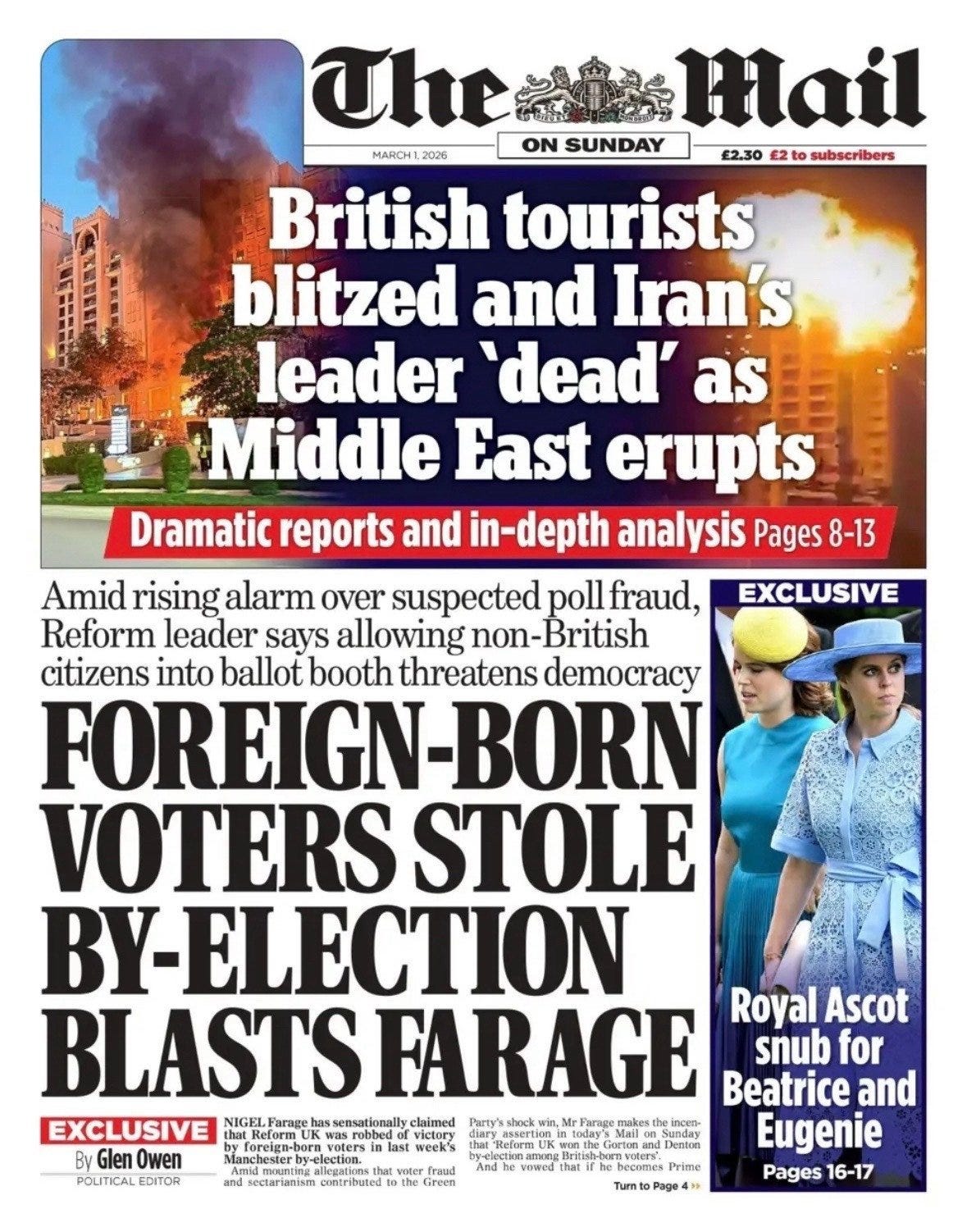
A party lost a by-election in Gorton and Denton.
That is not news. Parties lose by-elections constantly. They blame turnout, organisation, messaging, the weather, the leaflet that arrived late. Losing is part of democracy.
What followed was different.
After the result, Reform’s candidate Matt Goodwin warned of “dangerous Muslim sectarianism” and questioned whether the election had been free and fair. Nigel Farage went further, alleging cheating and suggesting non-British voters had shaped the outcome.
Pause there, because the word matters.
Sectarianism has a meaning. It describes a society where people vote only for their own religious or communal representatives. Catholics vote Catholic. Protestants vote Protestant. One community refuses to accept political authority from another. So what actually happened in Gorton and Denton?
Many Muslim voters backed the Greens, a party led nationally by a gay Jewish man and represented locally by a white working-class woman. Younger white students and graduates did the same. So did parts of the traditional older Labour vote. The coalition crossed religion, ethnicity and background.
If Muslims had voted for Muslim clerics while white voters rallied behind an explicitly anti-Muslim candidate, you could plausibly talk about sectarian politics. Instead the opposite occurred. Different communities voted together for the same secular candidate in a mainstream party.
Nothing unusual had happened. Citizens had voted. Yet the complaint was not really about campaigning. It was about the electorate. The argument was no longer: we failed to persuade people. It became: these people should not have been decisive.
Once you move from criticising votes to questioning voters, you are no longer arguing about policy. You are arguing about belonging. That is what sectarianism actually is. It appears when democratic outcomes are accepted only if they are delivered by the “right” population. The dispute stops being about what was decided and becomes about who was entitled to decide it. The reaction to Gorton and Denton matters for one reason above all others. It shows that this way of thinking has entered mainstream British politics.
When Losing Felt Normal
For most of modern British history elections settled arguments. Governments were loathed, mocked, protested against and sometimes swept away in landslides. Yet their authority was still recognised. Thatcher could win three elections and remain legitimate to her opponents. Blair could win in 1997 and still be accepted by his critics. Losing did not feel like exclusion. It felt like defeat.
That stability rested on something rarely stated aloud. The institutions of the state, the national story and the symbols of public life reflected English historical experience. For much of the twentieth century Britishness and Englishness were closely intertwined, so English identity did not appear as one identity among many. It appeared as neutrality or normality. Many English people therefore did not experience themselves as a group at all. They experienced themselves simply as ordinary society.
Other citizens understood belonging differently. Scots and Welsh voters maintained more developed national identities alongside Britishness. Irish, Jewish, Caribbean and South Asian communities in England belonged to Britain while recognising it did not fully mirror them. Their citizenship was layered. Because the majority rarely had to think about identity, politics felt like disagreement within a shared public rather than negotiation between different ones.
When the country later became visibly multinational and multicultural, many citizens simply saw identities they already possessed publicly recognised. A large part of the English majority experienced something different. They were not losing citizenship or rights. They were discovering that what had long felt neutral was in fact particular.
This realisation unfolded alongside a wider cultural reckoning. For much of the nineteenth and early twentieth centuries, being English carried an often unexamined sense of authority. The Empire was a source of pride. The rest of the United Kingdom and the wider world were frequently viewed, sometimes sympathetically and sometimes patronisingly, as places that would benefit from becoming more like England.
Late twentieth-century debates about empire, racism and historical injustice did not simply add new information. They changed the moral framing. The national story was no longer only one of progress and leadership but also of domination and harm. For some citizens this was an overdue correction. For others it felt like a sudden inversion. Characteristics that had never needed explanation were now being explained, criticised and historicised, and what had once carried quiet prestige was experienced as public reproach.
The discovery did not remain reflective for long. When people begin to see themselves as a defined public, politics attaches quickly to boundaries. Questions that once seemed administrative begin to feel constitutional. Not everyone responded this way, but a consistent pattern appeared. Voters who identified more strongly as English than British were more likely to support Brexit, more sceptical of immigration, more hostile to supranational courts and more resentful of perceived asymmetry within the United Kingdom. The common thread was not policy detail. It was legitimacy: a belief that political authority should visibly reflect the majority culture of the country. Disagreement therefore began to feel less like normal democratic conflict and more like a question of rightful ownership.
A democracy becomes unstable when losing an election stops feeling like being persuaded by fellow citizens and starts feeling like being governed by outsiders. The political question quietly changes from what should government do? to who is entitled to decide?
Brexit expressed that shift.
“Take back control” resonated not because voters studied trade law but because it addressed legitimacy. It promised a direct link between a recognisable public and traditional political authority. Supporters wanted democratic restoration. Opponents feared constitutional rupture. Both were responding to the same uncertainty: who sovereignty belonged to.
The 2019 election temporarily calmed the question. “Get Brexit Done” reassured many voters that the system had heard them. But reassurance is not resolution. Leaving the European Union could change law. It could not settle belonging or improve material conditions. Daily life did not suddenly feel better or closer to Westminster. Authority still flowed through courts, institutions and mediated politics.
The Parties and the Public
The political system then tried to manage a problem it did not fully name - Englishness.
Both major parties eventually oriented themselves toward the same English electorate. The Conservatives leaned into recognition, promising borders, sovereignty and national confidence. Labour pursued reassurance, organising its strategy around the imagined decisive voter in post-industrial England: socially conservative, supportive of Brexit, anti-immigration, and culturally uneasy with activism and progressive language.
Neither approach resolved the underlying question, because Britain no longer contains a single uncontested public. Voters began sorting themselves differently. Some moved toward parties expressing a plural civic idea of the country, notably the Greens and Liberal Democrats. Others moved toward Reform, which offers a clearer majoritarian definition of the nation. In Scotland, Wales and Northern Ireland, separatist parties saw their vote share increase.
So the divide is no longer simply left versus right. It is between two ideas of democracy. One sees democracy as majority rule by a ‘familiar’ national community. When outcomes do not match that expectation, legitimacy is doubted. The other sees democracy as legitimate precisely because citizens differ and institutions exist to manage those differences.
Seen from within the first view, the Gorton and Denton result did not look like defeat. It looked like malfunction. The voters themselves became evidence the system had gone wrong. Which returns us to the accusation of sectarianism.
A democratic outcome was rejected because of who participated decisively. That is not merely a complaint about politics. It is a sectarian response to democracy. Northern Ireland shows the mechanism clearly. The conflict there was never theological. It was about whether one community would accept authority from another and which electorate counted as legitimate. Elections alone could not settle the dispute because the dispute concerned the boundaries of the legitimate political community itself.
Mainland Britain long believed it was immune to this problem because it believed it had one people. In reality it had a shared assumption. As that assumption fractured, the same legitimacy tension began to appear. This is why British politics now feels unstable.
The rise of Reform and the rise of the Greens are not unrelated. They are competing solutions to the same question. One narrows the definition of the public so outcomes feel legitimate again. The other expands it so legitimacy rests on equal citizenship.
Britain is not simply polarised. It is arguing about what the country is. Elections should decide who governs, not who belongs. When a legitimate defeat is experienced as exclusion, democratic stability cannot last.