

Britain keeps experiencing Middle Eastern wars as sudden emergencies. Each appears as an unpredictable crisis: missiles, retaliation, allies under threat, difficult decisions taken under pressure.
But they are not sudden and they are not accidental.
The same decision keeps arriving because the same policy keeps producing it. Britain is not repeatedly dragged into Middle Eastern wars. It has built a system that repeatedly places it in them.
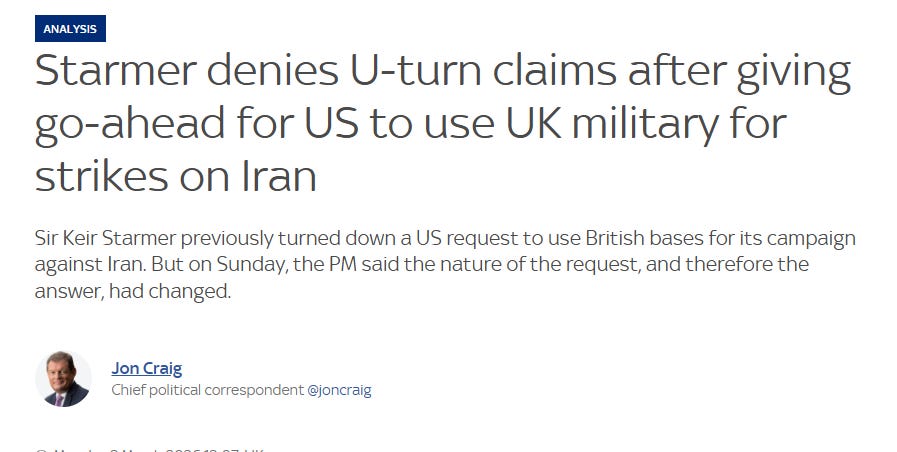
Stephen Bush’s recent column is useful because it expresses the respectable Westminster view with unusual clarity. Writing about the government allowing the United States to use British bases after the Iran strikes, he argues that once missiles were flying and British nationals were sheltering in the Gulf, maintaining a “no involvement” position would have been “a fantasy”.
It is a serious argument. It is also revealing.
Bush is describing a constraint. What he does not ask is why Britain repeatedly finds itself in situations where the constraint operates so predictably.
After the US-Israeli strikes, the UK authorised American use of British facilities for attacks on Iranian missile launchers, justifying the move as collective self-defence and protection of British lives. Once retaliation began, involvement was presented as unavoidable.
Yet other allies faced the same crisis and acted differently. Spain hosts major US military bases at Rota and Morón. It prohibited their use in the Iran operations, insisting they comply with the UN Charter and existing agreements. American aircraft relocated elsewhere. The alliance did not collapse.
France condemned escalation and called for diplomacy while stressing it had taken no part in the strikes. Germany and other European governments followed the same pattern: political alignment with Western partners, but little actual operational participation.
The difference becomes striking in the joint statement issued by France, Germany and the United Kingdom. All three governments called for restraint and a diplomatic solution. Their reading of the crisis was almost identical.
Yet the practical consequences differed. France and Germany limited themselves to diplomacy. Britain, while signing the same appeal for de-escalation, authorised the use of its territory for strikes.
The important fact is not that Britain chose involvement. It is that Britain appears to be the ally least able to refuse it. Britain is not merely allied with the United States. It is embedded within an American-led security architecture. Intelligence systems, targeting, basing, logistics and regional deployments operate as an integrated network. When the United States conducts military operations in a theatre where that network exists, Britain does not face a purely political decision. It faces a systems decision.
This arrangement did not arise recently. It is the successor to an older strategic role. For more than a century British strategy in the Gulf has followed a recognisable logic: protect trade routes, secure energy flows and support friendly regimes in exchange for basing and influence. The empire ended, but the operational assumptions endured. The Gulf bases are not a temporary response to recent threats. They are the permanent descendants of earlier British commitments to manage the region’s political order, now incorporated into a wider American security system.
That architecture produces a circular logic.
The bases are justified by instability.
Instability requires supporting local illiberal regimes.
Supporting the regimes deepens instability.
Regional conflict makes the bases indispensable.
When conflict erupts, Britain does not so much decide to participate as discover it is already present.
The argument about British citizens under threat sounds decisive until one pauses. British citizens live in many dangerous parts of the world without triggering military participation. Likewise, Norway is unlikely to enter the war if Norwegian citizens living in Dubai are killed. What matters here is not simply citizens, but infrastructure. Britain is not merely observing events in the region. It is part of the operational machinery through which recurrent military action occurs.
Bush might be right about the immediate moment. Once deeply integrated into another power’s military operations, disentanglement during a live conflict becomes extremely difficult. But that observation should begin a debate rather than end one.
It is fair to ask what would have happened had the government refused. The consequences would not have been trivial. Washington would have reacted angrily. There would have been diplomatic strain and accusations of unreliability. Intelligence cooperation might have become more difficult for a time. But that is not catastrophe. Other allies have disagreed with American military decisions without ending their alliances or their security. Arguments would have followed but the relationship would have endured.
The significance of this episode is therefore not that Britain faced pressure. It is that British politics increasingly treats pressure as proof a decision cannot be taken. If every crisis produces the same conclusion, the conclusion is not caused by the crisis. It is caused by the policy. This is not an argument for isolation. Alliances are normal and often valuable. The question is whether an alliance enhances security while preserving agency, or whether it gradually removes the ability to decide when participation in war is justified.
British debate has become adept at observing entanglement while avoiding discussion of how to reduce it. The country is not only reacting to events in the Middle East. It is operating inside a strategic role it has inherited but rarely examines. Britain treats each Middle Eastern crisis as a new emergency. But a posture designed to keep Britain permanently present in the region will continue to produce them.
The question is no longer why Britain keeps being pulled into these wars.
The question is why it keeps arranging to be there when they start.